


A long list of companies can look like progress. But if you’re the person who has to decide which ones deserve a conversation, the real work is still ahead.
Which companies fit the brief? What makes them interesting? How much of the information can you trust—and what do you need to find out next?
At ontopraxis, we brought those questions into an AI-assisted M&A screening workflow. It’s a useful example of the work we enjoy: understanding a business problem, shaping the process around it, and building something the team can actually use.
🎯 The business problem
The work supported a confidential M&A engagement involving a UK technology company and its advisor. The starting point was a long list of potential acquisition candidates across a partner ecosystem.
The team needed a consistent way to compare those companies and focus its attention. That meant bringing together the basic screening criteria, the reasons a business might be a strategic fit, and the evidence supporting each assessment.
We built a single-page dashboard supported by AI-enriched research and human review. The aim was to make the next decision easier: which companies warrant a closer look, and why?
You can see the workflow in the five-minute demo. It uses synthetic company data to show the approach while protecting client information.
🔬 Giving the research a clear purpose
It’s tempting to research every company in depth. But before doing that, it helps to ask what decision the research needs to support.
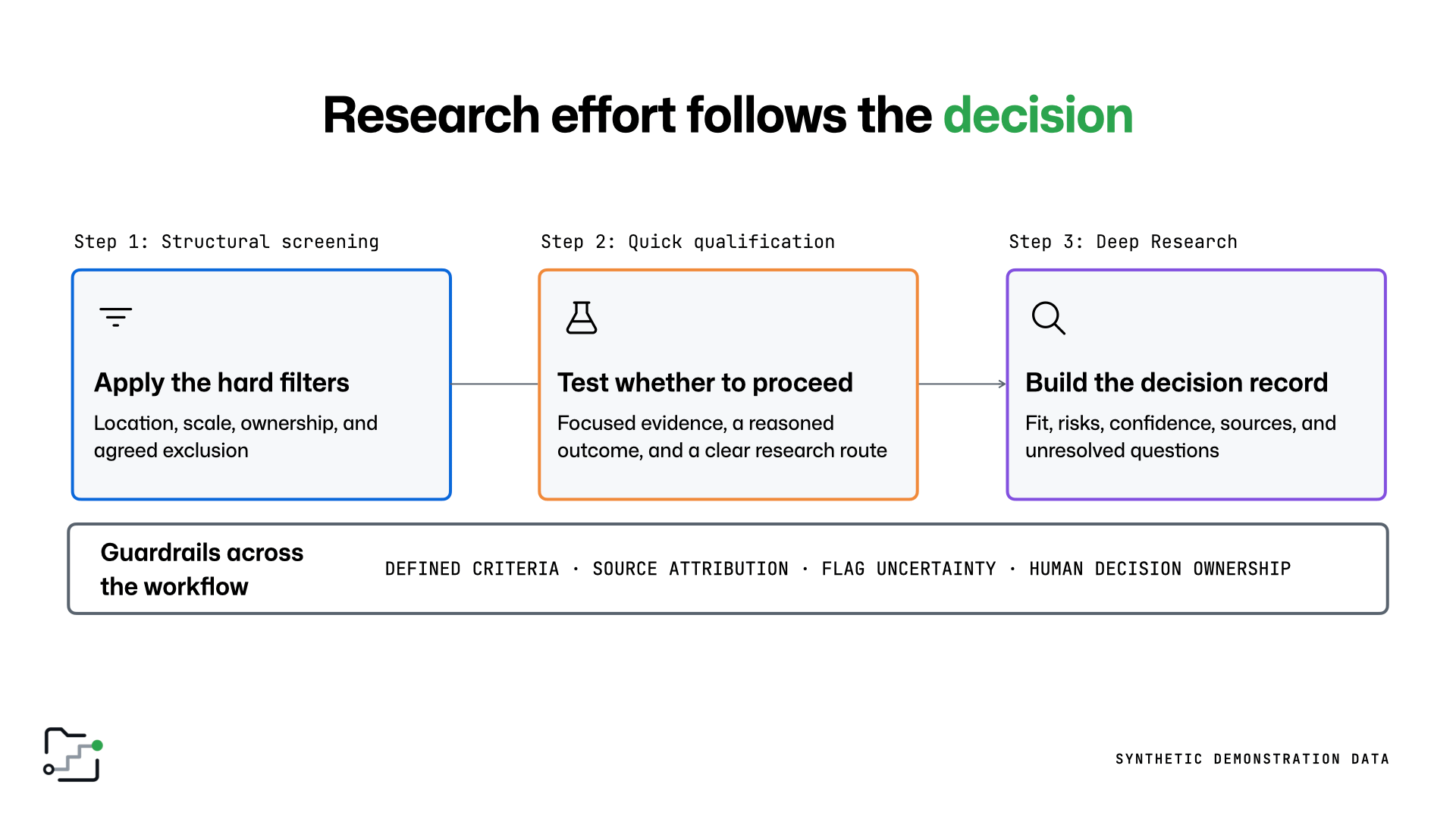
Our guiding principle was simple: research effort follows the decision. We organized the work into three stages.
1. Structural screening: does it meet the brief? Apply the hard filters—location, scale, ownership, and agreed exclusions. This establishes which companies fit the basic requirements.
2. Quick qualification: is there a reason to go further? Gather focused evidence, reach a reasoned screening outcome, and identify the next research questions.
3. Deep research: what supports the next step? For candidates that warrant it, build a fuller decision record covering fit, risks, confidence, sources, and unresolved questions.
🛠️ Turning the method into a working tool
The next challenge was to make that research easy to work with. We brought it into connected dashboard views so the team could move between the overall picture and an individual company:
Overview: See the target universe and distribution of screening priorities.
Master List: Compare candidates, search the list, and filter by priority or region.
Company Detail: Inspect an individual candidate’s business profile, strategic relevance, recommendation, and risk flags.
Evidence & Audit: Review the supporting sources and verification status behind the assessment.
The demo also includes a Funnel view to highlight screening progression. Together, these views let a reviewer move from the wider universe to a candidate’s assessment and its supporting evidence.
AI assists with research on business descriptions, ownership, vendor partnerships, ecosystem relevance, and diligence risk flags. We organize the findings into structured company records that feed the dashboard’s views and summary indicators.
That connection is an important part of the technical work. A useful finding needs a place in the record, a source the reviewer can inspect, and a clear indication of what still needs checking.
The toolchain behind the workflow
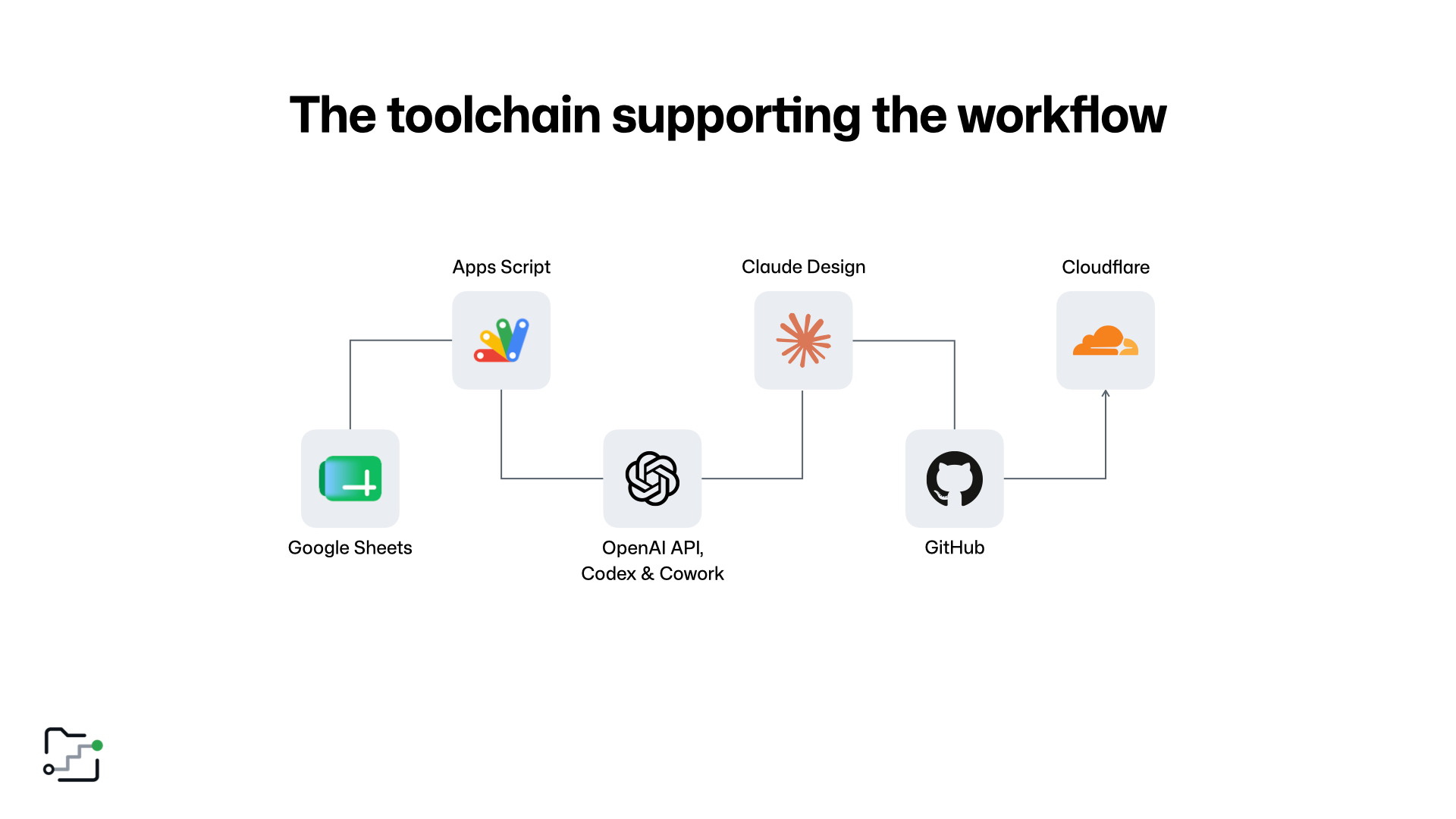
The supporting toolchain brings together Google Sheets, Apps Script, the OpenAI API, Codex and Cowork, Claude Design, GitHub and Cloudflare. It spans the research, data, design, development, and deployment work needed to turn the screening method into an application.
The choice of tools sits alongside the business design. The criteria tell us what to look for; the record structure tells us how to organize it; and the dashboard gives the team a practical way to review and use it.
🔎 Keeping uncertainty in the conversation
One detail in the demo is worth pausing on. A company can be marked High Priority and still be Partly Verified.
That’s useful information for the next conversation. The company may look promising, while some of the facts behind that view still need confirmation.
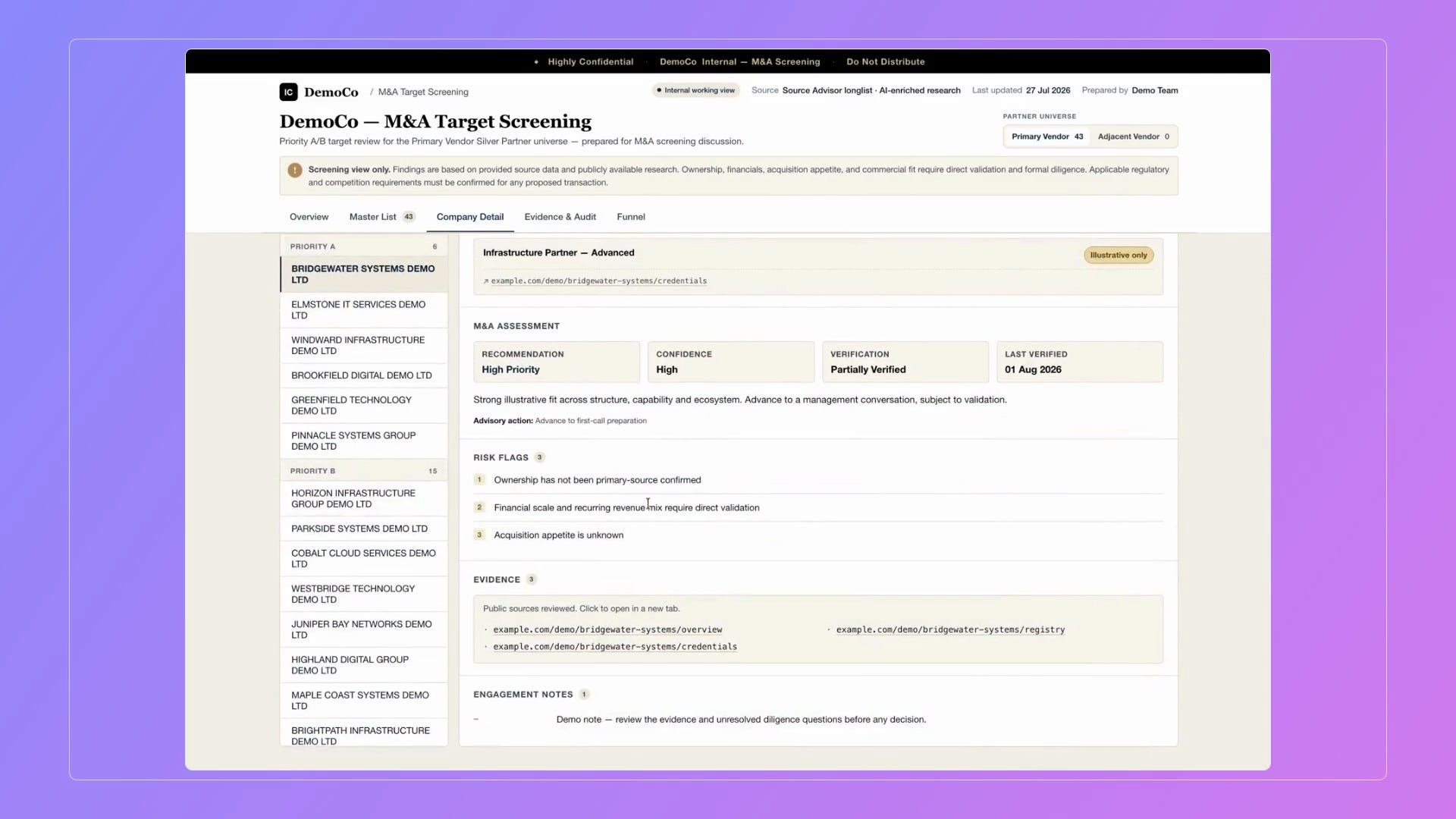
In the example, ownership has yet to be confirmed from a primary source, financial scale and recurring revenue mix need direct validation, and acquisition appetite is unknown.
Putting those gaps alongside the recommendation helps the team prepare: here’s why the company looks interesting, here’s the evidence, and here’s what we need to ask.
Across the workflow, we kept four principles in view: defined criteria, source attribution, visible uncertainty and human decision ownership. People review the research and own the next step, including direct validation and formal diligence.
💼 Bringing business and technical delivery together
This use case brings together several parts of our work at ontopraxis:
Business understanding: Translate an acquisition objective into practical screening criteria and a sequence of decisions.
Research and evidence design: Use AI to enrich the records while retaining sources, confidence, and open questions.
Application development: Build a usable dashboard around those records, connecting the overview, company assessments and evidence.
The tool has been used in the confidential engagement. What we delivered was a working way to assess the universe, compare priorities, and prepare for the next conversation.
For me, that’s a meaningful test of Applied AI: can we take a recurring research and decision problem and turn it into something useful in the team’s day-to-day work?
🌐 The wider applications
You don’t have to work in M&A to recognize this problem. Partner mapping, supplier assessment, and early commercial reviews all involve comparing candidates, checking evidence, and deciding where to spend more time.
The criteria will change. The underlying approach can carry over: understand the decision, structure the research, and build the tool around the people doing the work.
If you’d like to see how it comes together, watch the five-minute M&A screening demo
And if a similar research task or screening process comes to mind in your business, I’d love to hear about it. Let’s explore where AI could help.
Reach out at curious@ontopraxis.ai.
About this demo: The companies, figures, and assessments shown are synthetic and illustrative. This example demonstrates an AI-assisted screening workflow, rather than an investment recommendation. Findings require human review, direct validation, and formal due diligence before any transaction decision.